Rainbow in the Dark


This post is a layperson’s explanation of my paper Choosing a Maximum Drift Rate in a SETI Search: Astrophysical Considerations. Seem familiar? This particular essay is cross-posted on the Berkeley SETI Research Center blog here


Let’s do a thought experiment.

Imagine you’re out in space with your friend and they shine a green light at you. If your friend starts travelling towards you at a constant speed, that green light will appear a little bluer (called a blueshift) as the wavelengths of light get compressed. If they instead start travelling away from you at a constant speed, the green light will appear a little closer to yellow (called a redshift).

Now let’s take this a little further: imagine your friend starts at a standstill with their green light, and then starts accelerating towards you, moving faster and faster. What will you see? The light will start as green, and shift bluer and bluer as time goes on. This effect is called a Doppler acceleration, and it happens to any electromagnetic wave whose source is accelerating towards or away from you – including radio waves.

But let’s continue this analogy in visible wavelengths of light. Let’s say you’re looking for a flashlight from an extraterrestrial intelligence (ETI). We don’t know what color to expect – red, yellow, blue, purple, who knows what color the ETI have chosen. So we tell our computers* to search for bright spots in every color that our telescope can collect. But we have to be careful – if the color is changing throughout the observation, because of Doppler acceleration, the computer might miss it because it’s just looking for signals of a single color!

Okay, but why would the ETI’s transmitter (the radio equivalent of our flashlight from before) be accelerating in the first place?

Turns out, space is full of things that are constantly accelerating towards and away from us (radial acceleration). A planet orbiting a star is accelerating. A transmitter on the surface of a rotating planet is accelerating. A transmitter that’s orbiting a planet like a satellite is accelerating. Earth is accelerating around its rotation axis and around the sun as we try to take our data, causing the same issues via symmetry!

All of these effects stack, and cause a transmitter that is sending out a single wavelength of light to appear to change drastically over time.

In our new paper, we wanted to calculate exactly how drastically the wavelengths would change over time. We can tell our computers to search for these drifting signals through time, but we have to give them a maximum limit of how much drift to expect. So what’s the maximum?

To answer that question, we considered every planet in our solar system, every known exoplanet, all of the asteroids and comets in our solar system, orbits around main sequence stars, neutron stars, and even black holes. We calculated the fastest acceleration we would expect in each case, and what its expected Doppler drift would be.

In the end, we found that the searches for extraterrestrial intelligence in the past have used a maximum Doppler drift rate that was too small, leading to the potential for missed signals. Luckily, with the new guideline (200 Hz/s at 1 GHz, for those of you who want units) we should be able to catch signals from ETI no matter what the acceleration is like in their home system!

The new paper has been accepted to the Astrophysical Journal and is also available on the arXiv preprint server.

*there’s waaaay too much data for our team to go through it all by eye, so we have to write algorithms to find interesting signals for us
AAAS 2019 Pt. 3: Gesture as a Shortcut to Thought

Welcome to Part 3 of my AAAS 2019 conference series! For more background on the conference, see the first post in this series.

This post will be structured a little differently because the event was a topical lecture instead of a multi-presenter panel. This research was partially conducted by and entirely presented by Dr. Susan Goldin-Meadow, Professor of Psychology at the University of Chicago.

Gesture as a Shortcut to Thought

From the AAAS 2019 session The Gestural Origins of Language and Thought

New Jargon I Learned:

  • Homesign: The rudiments of a gestural language that deaf children use to communicate before they learn a standardized sign language.
    • Deaf children all over the world will invent their own homesigns!
  • Gesture-Speech Mismatch: A phenomenon that results when someone’s speech is conveying one message but their gestures are conveying another.

Overall Theme: There is a fundamental difference between gesture and communication, even if that communication is being accomplished via signing. Gesture is a more foundational link to how our brains are actually processing material than speech, and gestures both reflect and change what we know.

3 Interesting Study Topics in This Field:

  1. Homesign has been studied extensively by linguists and psychologists, as it is a unique window into how language develops. Researchers in this field once hypothesized that deaf children who use homesign were picking up the gestures of their hearing caretakers and incorporating those gestures into their homesign. However, if you map out the grammatical structures of homesign, you find that it has complex sentences and complex noun phrases that aren’t present in the gestures of their caretakers. This indicates that homesign is developed independently of hearing caretakers’ gestures.
  2. Another piece of the puzzle is the presence of distinct stages of a developing sign language. These stages were observed during the development of Guatemalan Sign Language (which was only standardized a few decades ago). First, every deaf child goes through the process of inventing their own homesign. At some point in that child’s life, they encounter others who are deaf and have their own homesigns, and a process of collaborative invention begins. However, research has shown that there are some elements of language which are never defined or delineated until the language has grown mature enough to be taught to a new generation. The transmission of a language to a new generation of signers actually produces linguistic alterations in the standardized form – there are parts of the language that are not invented until this stage!
  3. In another study, deaf children and hearing children were tasked with solving a math problem. Many children in both groups got it wrong. When they were asked to explain their reasoning to a researcher, most children would use gestures along with their words to help communicate their thought process. In most children, there was a gesture-speech match – their gestures illustrated the words they were using to describe their method. But in some children, their words would illustrate the (incorrect) method that they actually used, while their gestures showed a different, correct method! When both groups were taught how to do the problem correctly, these children with a gesture-speech mismatch correctly solved the next problem at much higher rates than those with a gesture-speech match! Even deaf students showed these same results. There are many possible reasons for this behaviour: gesture could be deeper-seated than language, so it could link the concrete action and the representation better than words. The mismatch could also be a tell-tale sign of a lack of confidence in the answer, creating students who are more willing to learn.

Fun Fact I Learned: Gesturing is natural even for people who are blind (and have never seen another person gesture in their life) or deaf (in an act entirely separate from signed communication).

Application: These studies (especially the one about gesture-speech mismatches) can help us improve education. Gesture lets us express ideas in an imagistic manner, while words let us express ideas in a categorical manner. Having an understanding of a topic on both levels will lead to deeper learning. From what I gathered here, allowing students to learn kinesthetically (ex. practicing explaining topics on a blackboard, a setting with natural gesturing) may prove more effective than solely stationary methods.

AAAS 2019 Pt. 2: How People Learn

Here’s the second part of a multi-part series on the things I learned from the AAAS 2019 conference. For more background on the conference, see the first post in this series.

Without further ado, here are some fun facts, resources, themes, solutions, and jargon that I learned at AAAS about…

How People Learn

From the AAAS 2019 session How People Learn: A New Look

Fun Facts I Learned:

  • Groups of people who learn one numeric system or time system have regions in their brain that are differently shaped than those who learned different systems. Similarly, there’s a difference in the parts of the brain that expert abacus users’ activate to solve problems compared to those who learned elementary math via other methods.
  • Some cultures place a higher value on learning by observation while others place a higher value on individual tutelage. Some cultures focus on individual capabilities while others focus on the ability to work collaboratively. Some cultures reward learners for precise imitation while others reward them for creative deviation from a model.
  • Common tools to motivate children in the classroom such as competitions, badges, and points do work well to increase participation for some students… but can lead others to disengage and assume that the material is not inherently valuable – the opposite of what we want as educators!
  • When comparing factors that affect a student’s learning at the high school level, the teacher is the most important school-level factor in a student’s academic success and engagement in a class – more than school funding, curriculum, etc.
  • When we learn, we draw on linguistic and cultural resources – mismatches in culture between students and teachers could be a part of the perceived underachievement of traditionally underrepresented groups. Or, to say the same thing in less of a word salad, if your teacher doesn’t look like you, it’s harder for them to understand where you come from and what you need to succeed.

Resources I Found:

  • How People Learn II: A huge National Academies of Sciences, Engineering, and Medicine (NASEM) report, released in 2018, that functions as a comprehensive (350 pages!) review of the science of learning and education from many different perspectives (psychology, sociology, neurobiology, etc.).

Good Quotes:

  • “Many funders and school systems act as if driving a van of computers up to a school will automatically enhance learning”
  • “Calling the underperformance of underrepresented students an ‘achievement gap’ focuses on the symptom – calling it an ‘opportunity gap’ focuses on the solution.”

New Jargon I Learned:

  • Model-based learning: A type of learning where the student first learns about the structure and properties of a model system (ex. that the moon goes around the Earth) and then uses that model to answer questions about the consequences of that framework.
    • The best model-based learning leads to successful answers to never-before-considered questions (ex. when does the full moon rise?).
    • This kind of learning is highly valuable, and thus highly emphasized, in science.
    • We should be aware that students and non-scientists may see model-based learning as 1) unnecessarily complicated 2) an unfair cognitive tax and 3) an obstacle to getting “the right answer” quickly and efficiently (as compared to memorization).

Short-Term Solutions:

  • We need to use assessment to advance learning, not as an end goal, but as part of a process. The feedback given should be chosen to help the learning and also be concretely addressable by the student.
  • We need more discipline-specific tools in science to really help model-based learning (paper/web based tools are nice, but physical models and exposure to actual scientific equipment are far better).

Overarching Themes:

  • Specifics about the way that we have learned different concepts in the past, or the skills that we’ve acquired, have directly measurable effects on the physical shape and functioning of the brain.
  • Different cultures have different methods of conceptualizing learning, and there is no default culture.
  • Science education needs to focus more on model-based learning while being aware of the frustrations that it can cause to students who are unfamiliar with it.
  • Teachers are the most valuable resource that a school has!

Best Moment: Learning that because violinists use one hand (their chording hand) more than the other, the “violin” region of the brain on the dominant side grows to be larger – in proportion to the experience of the violinist! The regions that correspond to the thumb and pinky finger (we have the resolution to see this!) literally grow farther apart in the brain, and there’s a correlation between that distance and the number of years that the violinist has been playing.

Personal Action Items Inspired by These Talks: 

  • Construct a room-sized orrery in Davey Lab at Penn State.
    • Many of the most complicated general astronomy topics (moon phases, eclipses, etc.) can be much more easily understood by looking at a physical model. And model-based learning is a great way to teach non-scientists what “thinking like a scientist” is actually about. Being able to switch perspectives by physically walking from the Sun to the Earth to the Moon, and looking at the way that the Sun’s light interacts with the Earth and Moon, would be a fantastic learning tool. Perhaps I can convince someone to let me do this if I make it an easy-to-install-and-remove demo…

***

This session had more of a panel format, and I didn’t catch the names of everyone involved, but here are the names of the three speakers on the program.

Presenters:

  • Rob Goldstone, Indiana University Bloomington, Psychological and Brain Sciences
  • Art Graesser, University of Memphis, Psychology and Intelligent Systems
  • Barbara Means, Digital Promise, Educational Psychology

AAAS 2019 Pt. 1: Fake News

Here’s the first part of a multi-part series on the things I learned from the AAAS 2019 conference. AAAS is the American Association for the Advancement of Science (not to be confused with the astronomers’ AAS) which works on science policy, education, advocacy, and diversity and inclusion issues. I primarily attended the conference as the co-leader of Penn State’s Women and Underrepresented Genders in Astronomy Group (W+iA) along with my colleague and fellow co-leader Emily Lubar.

Originally, I was going to have each day of the conference be a separate post, but there was far too much information in each day to make that in any way tractable. So instead, I’m breaking it down by topic – this particular topic only had one session, but future posts may combine multiple sessions on the same topic.

Here are some fun facts, resources, themes, solutions, and jargon that I learned at AAAS about…

Fake News

From the AAAS 2019 session Fighting Fake News: Views from Social and Computational Science 

Fun Facts That I Learned:

  • The most viral fake news stories were shared more before the 2016 election than the most viral real news stories.
  • Only 15-30% of people believe fake news on first glance, but this number doubles if the information resonates with our existing biases.
  • There is no measurable relationship between exposure to fake news articles and change in voting behaviour in the 2016 election.
  • 25% of highly educated Trump voters will say that the photo of Trump’s inauguration has more people in it than photo of Obama’s – here, vocally denying fact is another way to express an opinion.
  • There’s a low correlation between quality of online information and its popularity. This is more prevalent when the quantity of information is high and your time to digest it and fact-check it is low.
  • More partisan people are more vulnerable to fake news.
  • If you remove the top 10% of bot-scores on Twitter (accounts that are deemed likely to be bots by the Bot-O-Meter mentioned in the next section), you get rid of almost all of the links to low-credibility sources.
  • Facebook is the social media platform that plays the biggest role in the spread of fake news, and it’s shared at the highest percentage by the demographic aged 60 or above.

Resources I Found:

  • Bot-O-Meter: An online tool for Twitter to determine how likely an account is a bot, developed by the Network Science Institute (IUNI) and the Center for Complex Networks and Systems Research (CNetS) at Indiana University. You can also check an account’s followers and friends.
  • Hoaxy: An online tool developed by the Network Science Institute (IUNI) at Indiana University that helps visualize the spread of certain claims and fact-checking across Twitter. You can see animations of the spread of certain claims over time, and which nodes in the Twitter network are likely bots (using Bot-O-Meter scores).

Overarching Themes:

  • To quote Twenty One Pilots, don’t believe the hype! Garden-variety misinformation (constant, intentional, factual errors) are far more dangerous than news articles about made-up stories.
  • Fake news is more a reflection of our polarization than the cause.
  • The people who spread fake news are never exposed to the debunking material because they happen on two different sides of the algorithmic social media network (ex. the shares of fact checking sites on Twitter never interact with the shares of the original fake news).
  • If you put together a toy model that only has social influence (where each node influences another towards its position when they share across the link) and unfriending (each node has a small probability of disconnecting from another node that’s too far from its position) you end up with echo chambers naturally – they are inherently built-in to the design of current social information infrastructure.

Short-Term Solution:

  • In order to fight the fake news epidemic, we need to convince Facebook to make all social media ads and their microtargeting information public.

Long-Term Solution:

  • We need to redesign our social information infrastructure to make it harder for disinformation to propagate.

New Jargon I Learned:

  • Selective Exposure: Seeking out facts to confirm pre-existing biases.
    • Most people don’t actually do this, but the people who do it engage in it a lot. These people tend to be at the extreme ends of the political spectrum (most liberal and most conservative), but those who are more conservative are doing it more in the current political climate.

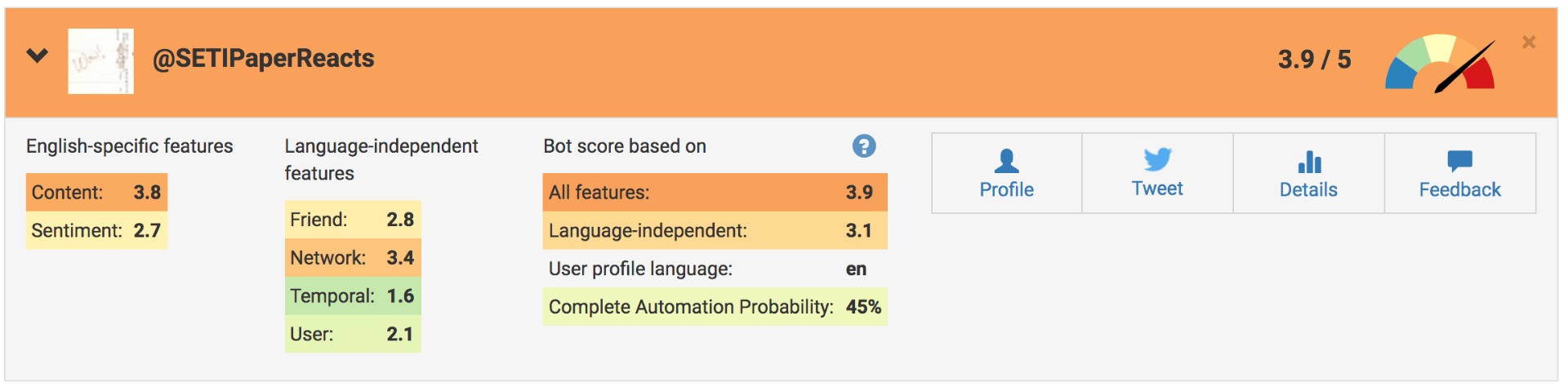
Best Moment: According to Bot-O-Meter, my heavily themed Twitter account (@SETIPaperReacts) is probably a bot – 45% “Complete Automation Probability”. I only wish I could automate my paper reading!

I’m probably a bot – sad!

Other Uncategorized Thoughts:

  • When trying to understand “fake news”, we have to understand the interplay between factual truth and authenticity: they are not the same thing. It’s hard for us, as scientists, not to equate the two. It’s certainly hard for me to understand why someone in power would tell an easily disproven untruth. But telling an untruth shows that you’re flouting a norm of truth-telling, which shows your contempt of the establishment, demonstrating authenticity. Authenticity wins out when the legitimacy of the system is questioned and when the elites have abandoned the public. The legitimacy of the system is questioned both for valid reasons and because of deliberately propagated disinformation (hence the fake news problem).
  • Fake news stories hang around – you have to look at their effects as long, complex networks over years.
  • Bots in coordination with a fake news source will retweet within a few seconds and they systematically reply to high-popularity accounts… but most of their retweets are done by humans. Bots are like viruses, and they’re effective!

***

It’s very hard to keep track in my notes of exactly who said what, but I want to give credit to the three presenters in this session, listed below!

Presenters:

  • Brendan Nyhan, Dartmouth College, Government and Quantitative Social Science
  • Stephan Lewandowsky, University of Bristol, Cognitive Psychology
  • Fil Menczer, Indiana University Bloomington, Informatics and Computer Science