Breakthrough Discuss 2019 (3/3): Conference Meta-Commentary

Welcome to my third and final post about Breakthrough Discuss 2019 (here’s Part 1 and Part 2)! It’s time to get ~meta~.

As scientists, we spend a good deal of our professional energy on conferences. We prepare (never early enough) for talks and posters, we spend packed days in conference rooms frantically networking and scribbling notes and eating pastries, and we build and leverage those professional connections and collaborations over time. Conferences are important. And that’s why conferences need to be equally accessible to all professionals in the field regardless of their career stage or identity.

In addition, we take days out of our very busy research, teaching, and outreach schedules in order to attend these events. Ask any scientist anywhere: neglecting your inbox for even a few days is a virtual disaster when you return. So these events need to be productive enough to offset the lost time, spent money, and additional stress of travel.

For both of these reasons, I wanted to reflect on the conference from a meta-level. How can conferences be more inclusive, and where did this one fail to be? How can we make more scientific progress in the couple days most conferences allow us? I don’t have full answers to these questions, but here are a few of my thoughts.

Lack of Inclusivity

Specific to Women in STEM

  • I recently saw an article that referenced an unfortunate inverse relationship between the way women in politics are perceived – you can be seen as charismatic or competent, but rarely both. This happens at conferences as well. When a female speaker is enthusiastic and emotive, the question section is full of “mansplainers” who seem to equate this openness with a lack of competence. This is incredibly unfair, especially for those of us who are very passionate about our work and enjoy sharing our excitement with technical audiences. It’s insulting to the speaker and wastes everyone’s time (see Terrible Question Bingo below).
  • Panels where female experts are constantly interrupted, talked over, and interrogated produce an extremely uncomfortable environment for me as a watcher. This provides a huge distraction from the science at hand (completely apart from the content that is lost by exclusionary behaviour towards the speakers). How hard is it to wait to start talking until someone else has finished?
  • There was a lot of adulation for Francis Crick, without a mention of Rosalind Franklin. I’m not that familiar with Crick’s work outside of the great DNA bamboozle, maybe the particular mentions were entirely unrelated to Franklin’s work… but I’m not convinced.

Other

  • For a conference about concepts as lofty as this one, we sure put a lot of ugly, embarrassingly human biases on display. For example, in discussion of panspermia, space exploration, and planetary protection, colonialism metaphors were everywhere. The immense problems with colonialism? Barely discussed. Here are some others I noticed:
    • Teenagers assumed to be male
    • Inventions assumed to be a product of western civilizations
    • Mothers assumed to take care of children
    • All species assumed to want other species to be like them
  • This conference was very, very white. Which is true of many astronomical conferences, but I feel like this is one of the places where that contrast is particularly ridiculous and stark. When we’re thinking about these huge questions in astrobiology – the origin of life, the development of intelligence, the future of humanity – it underscores how ridiculous it is that such a homogenous group is deigning to speak for our entire species. How ridiculous it is that we’re pondering these global questions about biodiversity as if we are trying our hardest to answer them when we haven’t even included the diversity of Earth’s human population? And how ridiculous it is that many people in that room still refuse to acknowledge that this problem even exists? We need to do better in SETI and in astrobiology as a whole.

Loss of Productivity for Other Reasons

  • The biologists, astronomers, and chemists are all awful about using jargon from their fields. This conference is interdisciplinary – we want to talk about big picture ideas and we need to all understand each other! Astrobiology in particular is a very tough field to work in because of this issue. I wish there was a way to provide feedback after conference presentations about the level of understanding from the audience, to help shape these conferences in the future and really be able to make headway on interdisciplinary issues.
  • I found that the discussions of ethics were too few, too cursory, and too dismissive. Often, when they happened, it was only because of a prompt from a female conference participant. Everyone needs to think about the ethics and societal impacts of their work and the assumptions behind it. Acting ethically is not gendered!

Terrible Question Bingo

Questions are vital to a healthy conference. They help clarify things from presentations, inspire avenues for new work, spread knowledge and expertise, and create connections between people and ideas. However, we all know that most conferences run behind, so only 1-2 questions usually get asked per talk. And those questions, per Chelsea Troy’s world-changing blog post on caucus-style meetings, usually get asked by people who raise their hands the fastest and talk over anyone who tries to stop them. The worst part is: these questions are usually not even good.

As the conference progressed, I began to make a list in my notebook whenever a particularly useless question was asked. Then I grouped them into the following “Terrible Question Bingo” categories.

Terrible Question Bingo

  • “I fail to see how… [condescending, skeptical question]” (just because you didn’t understand something on first pass doesn’t mean the speaker is wrong – can be useful as clarification and much shorter if worded politely)
  • “Well, actually [possibly correct correction about minor point that isn’t the focus of the discussion and derails interesting dialogue]”
  • “This is a comment, not a question…” (save these for the speaker in private, they’re the one presenting not you)
  • “[Sharing your opinion, bonus points if you don’t specialize in the work]” (wastes the audience’s time)
  • “You should look into X person’s work” (given without context, this is probably technical enough to be a waste of most of the audience’s time – save these for the speaker in private)
  • “[Very technical question that takes a full 2 minutes, entire audience has stopped listening]”
  • “If there’s anyone in the room that doesn’t know this… [condescendingly explains relatively general concept before asking a question]”

Ending on a Positive Note

Just wanted to shout out a couple things I loved seeing at Breakthrough Discuss 2019. We have a lot of work to do, but it’s not all bad!

  • I heard a response I loved to a “do you know x author’s work?” question. The speaker immediately said “yes, and for the rest of the audience, here’s a summary what the questioner was referring to”. It brought the audience into the conversation, took the haughty questioner down a peg, and established the speaker as an expert. I hope to be able to respond to questions with that much poise in the future!
  • Not all questions were bad! Here were some of the classes of question I found particularly useful at Breakthrough Discuss.
    • Clarification of main points or assumptions that the work is based on
    • Asking the speaker’s opinion on work that was presented during the conference, or big recent results
    • Continuing the logic from the speaker’s presentation into a new domain and asking their opinion
    • Asking for numbers, applications, next steps of their work

I’m still distilling this useful/useless question dichotomy in my head, so keep an eye out for further discussions on the topic!

In summary: I learned a lot from Breakthrough Discuss 2019, and I had a great time. I think there are many ways to improve the atmosphere of the conference for future years, both in terms of productivity and inclusivity (which is also productivity by the way), and the best way to start that is by talking about it.
Breakthrough Discuss 2019 (2/3): Concepts to Ponder

Welcome to Part 2 of 3 of my Breakthrough Discuss 2019 series (start with Part 1). This post focuses on concepts that I didn’t know before, pieces of information that caused me to change my perspective on something, and questions that I’m still thinking about post-conference. So without further ado:

Defining Life

One operative definition for intelligent lifeforms could be “physical systems who understand how the physical universe works”. As with any definition for life, refinements and counterexamples can be quickly dreamed up, but understanding and quantifying natural laws (physics etc.) is an interesting criterion. This was brought up by Sara Walker with the example of “anti-accretion”: the way that humans have sent mass up into Earth orbit from its surface, based on our understanding of the law of gravitation. Perhaps I’d add a caveat to this definition: “physical systems who understand how the physical universe works and use that to affect significant change in their environment“… but maybe that’s just the technosignature hunter in me!

An operative definition for life in general, put forth in the second panel, was “a unique chemical process with a boundary condition separating entity from non-entity”. Again, there are issues with it, but I like thinking about the “boundary condition” argument and, in the way of a good SETI scientist, wondering what it would look like if that assumption was broken. We definitely spend some time thinking about what would happen if, temporally, there was a gradient between non-life and life. But what if there was a spatial gradient? There’s a sci-fi short story in here somewhere…

Determining Atmospheric Compositions of Exoplanets

We cannot accurately retrieve atmospheric compositions of exoplanets even if we have JWST and TMT observations without knowing the mass of the exoplanet first (degeneracies appear because of mass – log(g) – temperature – scale height relationships). I didn’t realize until this conference that the precise determination of masses would be so vital for atmospheric studies (ex. biosignature gas searches).

Adapting Earth-life for Space

In one of the panel discussions, it was brought up that Earth life has an eerie tolerance for vacuum. Upon hearing this, of course, I immediately got excited. However, it was quickly pointed out that this is likely because vacuum-tolerance (and radiation tolerance) is related to the same mechanisms that protect against dehydration on Earth: very good DNA repair. So it’s not quite evidence for panspermia, but it does make me feel more optimistic about life surviving such a seemingly inhospitable journey in the first place.

But, to my surprise, it turns out that microbial communities and biofilms are far more important in thinking about how bacterial life survives than the analysis of a single microbial genome. The focus on single genomes is an incorrect simplification. Most bacterial strains cannot be cultivated in the lab because they are missing molecules from their original environment, a physical site of a certain structure to attach to, or another organism making something they need. If we ever send life elsewhere, we’ll need to send a full microbial community. This additional complexity is both beautiful and frustrating (to a non-biologist!).

Almost as a consequence of that realization, it’s also possible that Earth life may’ve spent too long adapting to Earth to be useful in a bioengineering (for ex. Mars terraforming) sense. Starting from scratch with synthetic minimal cells (customizable molecular machines that can be built with simple modular recipes) might be easier in the long run. These synthetic minimal cells could be pluripotent, could perform horizontal gene transfer, and could function as genetic circuits (biocomputing) or nutrient/chemical factories. I find not only the possibilities fascinating, but also the outlook of those performing this research; their synthetic cells are just little biochemical machines, and are not alive in any reasonable sense of the word. Oooh, biology is squishy…

Anthropocentrism, Directed Towards Microbes

Microorganisms are not primitive, they have as much evolutionary history as humans and are exceedingly complex, hardy, and good at what they do. I’m definitely guilty of underappreciating them, and I think this conference is a good reminder that non-intelligent, single-celled life is still fascinating.

With a sample size of one, it’s hard to know what properties of life are universal, and which are just funny terrestrial adaptations or random consequences of our particular evolutionary path. For example, are assumptions that all life must have a backbone, a motor, and a ribosome just physics… or terrestrial arrogance?

Probabilities and Rates of Panspermia

Let’s assume abiogenesis is pretty hard and happens slowly and rarely. Then the earlier life is detected on Earth, the more attractive panspermia becomes, which is a cool test! Except it assumes abiogenesis is hard, which is a pretty big assumption.

The rate at which we see life in the universe is a product of the rate at which it emerges and the rate at which it migrates. High origination negates the need for panspermia as a theory. If panspermia did happen in this scenario, any place that the migrating life landed would already be inhabited by lifeforms, thus leaving the rate at which we see life in the universe unchanged. On the other hand, high migration rates can spread life through the universe even if origination rates are low, so panspermia could provide astrobiologists an escape hatch from a tough abiogenesis situation.

Organoid Brains

At this conference I learned that we are growing embryonic stem cells from humans, apes, etc. into “organoid” brains. Not only can we grow these organoids, but we can also use CRISPR to see what happens to them if you modify parts of the genome. Turns out, if you use CRISPR to take out the NOTCH2NL gene, the organoids develop small and stunted – NOTCH2NL appears to be responsible for macrocephaly. It’s amazingly cool that we can determine this experimentally. On the other hand, these organoids produce some amount of electrical activity. Messing around with brain organoids that are evidently active without knowing much about the development of consciousness/intelligence seems reckless. Admittedly, I don’t have any background knowledge here, so maybe I’m making an ethical quandary out of a molehill, but I’m still very surprised about the lack of a single slide about the ethics; it wasn’t in the dialogue at all.

Messages from ETI Hidden in Genomes

A large, fun part of the conference was focused on the possibility that an extraterrestrial intelligence could have seeded the Earth / solar system with life long ago, and left us a message hidden in our genetic code. It sounds very sci-fi, but as with all things sci-fi, there’s no harm in giving it some methodological scientific thought.

However, messages hidden in genomes require a lot of assumptions. ETIs have to exist. Things have to be able to reasonably move from one stellar system to another. An ETI will need biological mastery greater than we have, and will need to have some motivation for bio-based messaging in the first place. They will also have to determine that the best possible way to message is through genetic code (this feels like the weak part to me, see next paragraph). And they will have to assume that living systems are inherently narcissistic in a way, to reasonably want to leave a message “inside” instead of “outside”. This large string of assumptions makes me pretty suspicious about the prospect.

The big scientific hurdle for bio-based messaging is mutation. Mutations happen a lot in biology. In fact, standard DNA codons have adapted to this by having a very specific set of characteristics to minimize the damage caused by random mutations. In other words, a mutation in the code rarely leads to a different amino acid being produced because there’s a lot of redundancy built in. So mutations happen, and then they stay, which is bad for messaging because it will scramble your message over time. On the bright side, we are already able to code something that will instantly stop replicating when a mutation occurs by immediately leading to an “error” or empty codon. This can currently be done with the production of only 15 amino acids, so a limited palette compared to what life has, but it seems possible that bio-engineering could lead to humans being able to leave a bio-based message in this way.

Instead of looking for “hello there” or pi or whatever else hidden in our genome, some suggestions have been made about looking for a “left turn” in our evolutionary pathway for no apparent reason. So something SETI-like to look for in a genome might be an infusion of information in the past that seems to hold a bad assumption and come out of nowhere (ex. a large piece of junk DNA coding for genes important for survival in an atmosphere that Earth has never had). I don’t quite buy this argument, it seems rather contrived, but I like the idea of it.

Convergent Evolution or Second Genesis?

The discovery of a carbon-based lifeform inside the solar system would not be enough to prove a second genesis of life, but, according to the second panel, the discovery of a lifeform with ribosomes would be. At what point between those two things do we stop expecting convergent evolution to be a reasonable explanation? I would love to get more input from biologists on this idea!

Planning for an Interstellar Journey

As soon as you produce a single piece of waste on a spacecraft, you have introduced a rate-limiting factor. We are working on ways to turn human waste into plastic, with the eventual goal of a 0 waste spacecraft. Even then, however, what happens if you forget something or encounter new and unforeseen needs on your journey? Do we bring DNA with us? Or chemicals/molecules/bases as building blocks? Or protons and electrons as building blocks for those?

Single Bad Actor Problems

Recently I’ve been mulling over the idea of domains in which a single bad actor can ruin everything. I have the following list so far:

  • Planetary protection (one company ignoring regulations could irrevocably contaminate ex. Mars)
  • Radio/light pollution (a single country building on the moon could destroy the idea of a far-side radio telescope)
  • Generalized AI safety (one programmer could intentionally/accidentally create malicious artificial life)
  • METI (one team with a radio telescope can send a message to the stars with potentially catastrophic consequences)
  • Nuclear weapons (one nation with a weapon could make Earth uninhabitable, for humans at least)
  • Peaceful protests (one rioter in a crowd of otherwise peaceful protesters can completely undermine the success of the protest)

I’m trying to think about the synergies in what seem like a very diverse set of endeavors, but this is probably a project for a game theorist, not me!

***

Part 3 of this blog series will provide perhaps my most important conference summary – a look at some meta-conference commentary. How can we make future conferences more productive and more inclusive? Stay tuned!

Breakthrough Discuss 2019 (1/3): Bite-Sized Thoughts

Over the past few days, I’ve been attending the Breakthrough Discuss 2019 conference in Berkeley, California. In general, the conference focuses on space exploration and the search for life in the universe, and this year’s theme was “Migration of Life in the Universe”. As of a few months ago, I’ve been trying a new strategy of condensing my conference thoughts into blog posts in order to record and order my thoughts and share the things I learned. I’m already behind – my AAAS 2019 series is unfinished, first post here. This time, however, I’ve decided to publish all three of my posts about Breakthrough Discuss at once.

This first post is a scattershot of interesting one-off notes: facts and figures that I learned, papers and resources that I will refer to in the future, quotes I liked from the speakers, and new jargon that I absorbed.

Numbers I learned:

  • In order to see observational evidence of the carbonate-silicate cycle on exoplanets, we would need observations of 11-51 different Earth-like planets in the habitable zone with LUVOIR. This is surprisingly doable!
  • Breakthrough Listen has a shiny new Open Data Archive, and you can download filterbank and raw voltage files from it. I get the feeling that Penn State might not be happy if I try to download 400 TB of FRB baseband data to the ACI cluster, though.
  • From argon-argon dating, shock petrology, and paleomagnetism, we can infer that some Martian meteorites have been heated up to 80C on the outer few millimeters, but no hotter.
  • The impact flux (rate at which meteoroids impact the Earth) was probably 500X higher at 4 Gya.
  • Life could probably be okay in a meteorite for ~10 Myr timescales.
  • According to Steve Benner, Earth probably had a ~0.25 Gyr window in which it could develop life.
  • At 3 Mya, human brains experienced a neocortical expansion by a factor of 3.
  • If ‘Oumuamua is representative, ~100 interstellar objects have likely impacted the Earth throughout its history.
  • Bacteria can self-replicate in 20 minutes.

Facts I learned:

  • The reason we see so many small bodies in mean motion resonance with Neptune is probably from resonance sweeping during Neptune’s migration (which is good evidence for this migration in the first place).
  • The Murchison meteorite smells like a sulfurous oil well because it’s so full of organics.
  • There is a gene called NOTCH2NL which is only found in humans. The Human Genome Project accidentally reported an incorrect place for it in the genome, leading to it being unexamined for years. Later, when the data was rerun, it was shown that NOTCH2NL actually resides in the macrocephaly region. Its appearance lines up with a massive increase in brain volume.
  • The insides of partially differentiated small bodies might be warm, wet, and organic-rich for tens of millions of years. This allows them to be potential carrying-cases for single-celled life!
  • There are four big challenges to be overcome in the process of panspermia:
    • 1) High temperatures during ejection could sterilize any fragments that did harbor life.
    • 2) Reaching escape velocity could cause high accelerations that would squash life.
    • 3) The vacuum / low pressures of space could desiccate life.
    • 4) The radiation environment of space could fry life.
  • The configuration of the solar system is far from optimal with regards to panspermia. The best case scenario would be a small central star, tightly packed planets, and resonances between those planets.
  • Resurfacing on the Earth implies that the oldest Earth rocks that we’ll find are actually on the Moon!
  • There are many genes (junk DNA) that are conserved in human DNA and we don’t know what they do.
  • Staph is no longer a pathogen in orbit, but salmonella is more pathogenic in orbit.
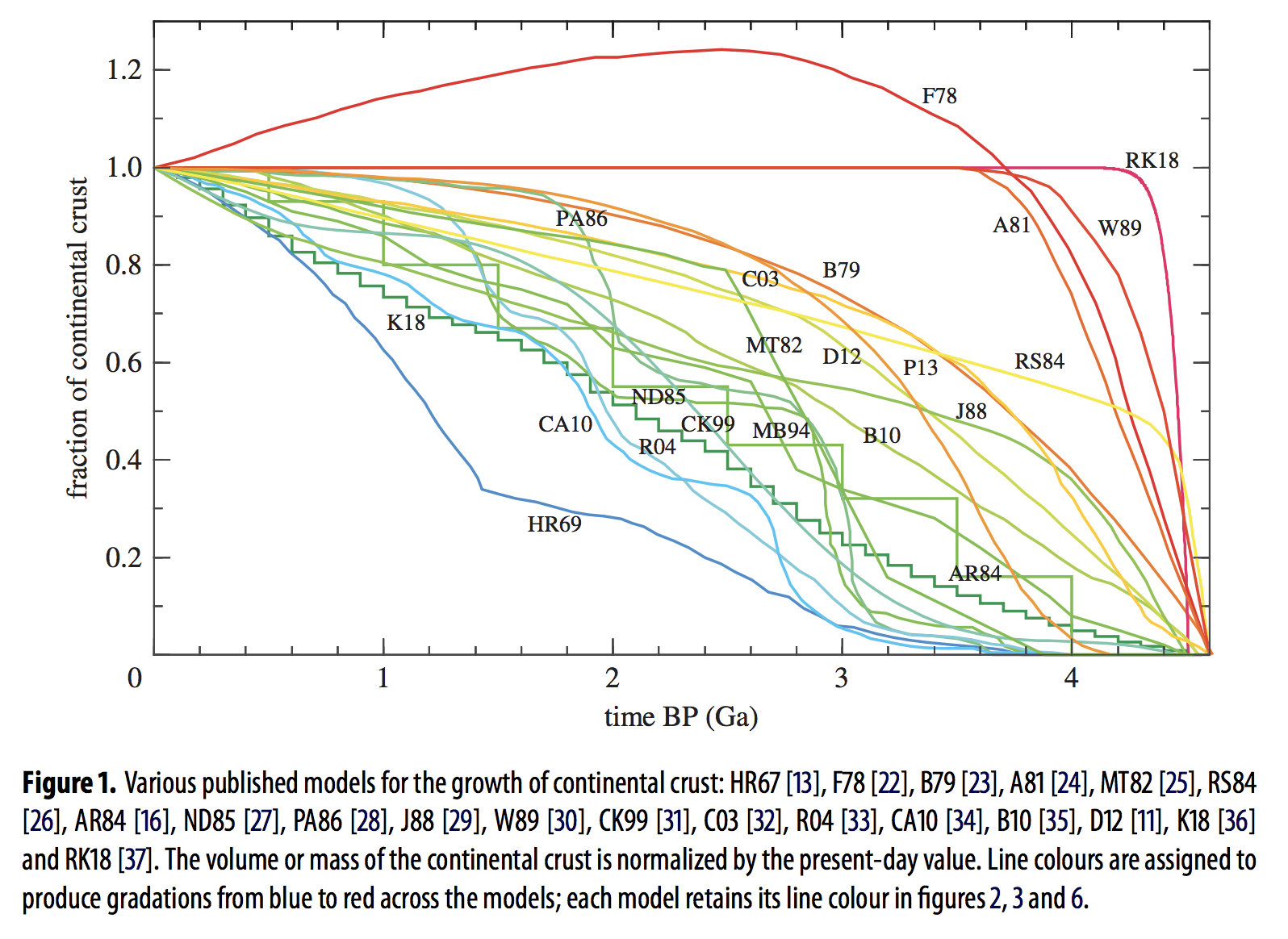
  • We have no idea how much continental crust existed in the Hadean (see figure).
Figure 1 from Korenaga 2018b showing how much models of Earth’s continental crust formation vary.

Papers I’m interested in reading:

Resources I became aware of:

  • Announced just weeks ago, Sandra Faber is putting together an Earth Futures Institute at UC Santa Cruz, thinking about sustainability and human systems over a million year timescale.
  • Foundational Questions Institute – An institution interested in supporting research on innovative physics/cosmology questions unlikely to be funded by other sources. Hmmm…
  • Sara Walker’s research group, Emergence, is focused on trying to find laws of life and applying them to astrobiological questions.
  • Oxford Nanopore – Tools that make genomic sequencing easy for anyone, anywhere.
  • DARPA Safe Genes – An organization thinking about research and integrated policy to prevent intentional or accidental genetic disasters, before we get to the point where we have the ability to make them happen.
  • Chris Kempes and Sarah Maurer are teaching an Origins of Life MOOC directed at first-year grad students starting in June!
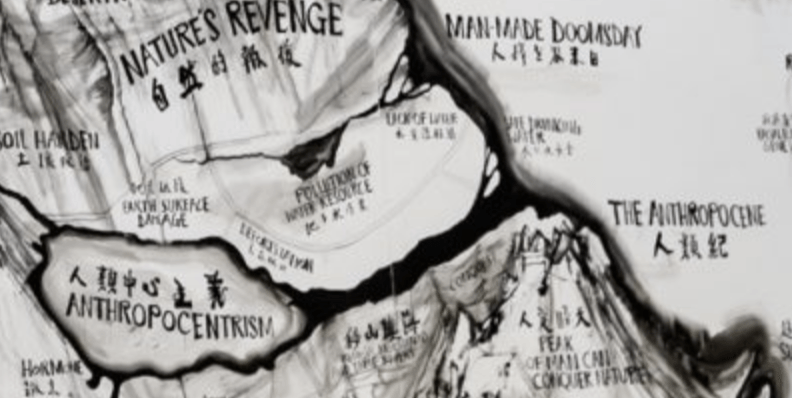
  • Natalie Batalha directed the audience to a piece of art called the Map of Technological Ethics by Qiu Zhijie. This 2018 work, to me, really helps visualize the immense, inherent complexity of the issues that we cannot avoid as scientists (and as humans). And in this piece, each small region of the map – each label – represents an incredibly complex and unresolved issue or concept. When we think about the evolution of intelligence / complex life, we have to explain a sentient system that deals with all of this – talk about emergence! It also provocatively asks “Why do we want to escape from Earth?”

https://learning.qagoma.qld.gov.au/artworks/map-of-technological-ethics/

Ahh, Anthropocentrism Lake, just west of Anthropocene Coast and southwest of Man-Made Doomsday Delta.

Great quotes:

  • “Who lives, who dies in this Anthropocene?” – Natalie Batalha
  • “I used to measure the shadows of Earths” – Kepler (yes the telescope, epitaph)
  • “Self-sustaining artificial life is seen as a threat” – Steve Benner
  • “The complexity of human society is far less than eukaryotic complexity” – David Haussler
  • “The worst place you can go on Earth is still infinitely better than plopping yourself down on Mars” – Lynn Rothschild, on why Mars is not a “Planet B”.
  • “Europa is basically an ice bedrock roof cave environment” – Penny Boston
  • “We need to explore for the right reasons” – Natalie Batalha

And my personal favourite:

  • “I’ve always wanted to be photosynthetic” – Penny Boston

New jargon I learned:

  • Spallation: “A process in which fragments of material (spall) are ejected from a body due to impact or stress” (Wikipedia). When talking about impactors hitting planetary bodies, this provides a relatively gentle way to get material just up to escape velocity, and thus provide a reasonable vector for panspermia.
  • Steppenwolf Planet: A planetary-mass object that orbits the galactic center directly (is not bound to a star) and could be habitable, thus providing another vector for life to travel throughout a galaxy. Synonym for rogue/free-floating planets coined in a 2011 paper.
  • Hachimoji DNA: A synthetic kind of DNA (and RNA) that has two synthetic base pairs (based on four synthetic nucleotides) in addition to the the four normal nucleotides. Gives DNA additional capacity to store information, and opens up new avenues for extraterrestrial life.
  • Bespoke Chemistry: Custom-made chemistry (I think?) that allows us to think about the origin of life from a synthetic biology perspective.
  • Optogenetics: A technique in genetics where cells (usually neurons) are genetically modified to activate in response to light, giving a way to precisely control and study them in the lab. Helps us learn about the development of intelligence.
  • Radioresistance/Radiotroph/Radiosynthesis: In order, organisms that can withstand a high-radiation environment (ex. Deinococcus radiodurans and tardigrades), organisms that harvest energy from radiation (ex. fungi around Chernobyl which actually need radiation to survive), and the process by which organisms harvest energy by radiation. Organisms that get their energy this way could thrive even in the high-radiation environment of space.

***

Part 2 of this blog series provides a more in-depth look at some conceptual ideas that I’ve been thinking about since the conference!